Reminiscences of musical events revolving around the extraordinarily talented individuality that Józef Krzeczek undoubtedly was even as a boy in his teens overwhelmingly make it necessary to offer that fact for public reflection.
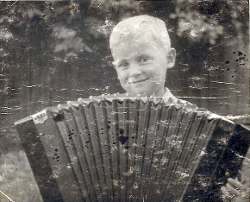
The place and the time, factors that explain the shaping of the young boy's personality, were - surprisingly - a favourable starting point for a future musical career under the roof of the secondary music school. An education in the piano class, applied in the form of practical perfecting of piano playing, was consolidated in the band called "Kolorowy Jazz". And above all there was the polishing of technical proficiency through frequent music-making in improvised instrumental line-ups formed "ad hoc" in the form of jam sessions. And what matters: those productions of syncopated music were made together with, and in confrontation with, the most seasoned aces of jazz. And these undoubtedly served as the most effective way of perfecting a craft that developed - on many planes - the musical skills of the young adept.
A source that consolidated the process of acquiring many-dimensional values and enriching the potential of his musical abilities was, for our hero and performer, also the exceptionally frequent concerts, including artistic tours. The wide range of stimulating influences on the shape of the musical prosperity of this vigorous and extremely receptive jazzman - outlined in the text above - does not yet exhaust, as accomplished facts show, its essential attributes.
Undeniably the supreme providers of jazz models, both for the generation of Józef Krzeczek then sprouting in this field and for the whole crowd of more seasoned jazzmen appearing in great numbers, were the musicians giving concerts in Poland more and more often, who came from European countries and especially from the American continent.
A sensation of its own kind was the after-concert jam session (in the 1950s) held at the Yacht Club with the virtuosos of the Big Band of Glenn Miller, whose dominant, classy improvised displays by no means daunted Józef Krzeczek. Unexpectedly he reached for a trumpet kept hidden up his sleeve, in order heroically to prove to one and all his considerable creative and multi-instrumental inspiration and to amaze both the musicians and the audience (an incredible fact) with a debut performance.
The conclusion that follows is unequivocal: it is extraordinarily heartening that an end has come at last to the string of such ruthlessly and painfully insulting opinions aimed at the Nowa Huta community, which against all adversities pressed on impressively, and still climbs, towards the heights of civilisation and culture. And here the reflection irresistibly comes to mind that the great time has undoubtedly come to grant Nowa Huta, and above all its inhabitants, the equal and worthy status of a district of great, cultural Kraków, with the addition of the fitting name of metropolis.
In this context an unimaginably expansive, hardly measurable scale of artistic performers of every kind, and thanks to them an improbable multitude of musical, vocal, theatrical, film and para-artistic offers of various types, crowned the celebrations of 60 years of Nowa Huta.
It is hard, then, not to acknowledge this culmination of the development of cultural and civilisational goods: from the very dawn of the forming of the foundations of Nowa Huta, the incoming population, both the youngest generation and the builders, and with them the urban generation shaping the face of the new town, were marked by an astonishing inclination towards all available forms of education, of culture and of world view.
In that radical - in the sociological sense - process of development Józef Krzeczek appeared as a singularly outstanding individual, a symbol of pride and a model in the sphere of musical gifts and of aspirations for the future, and with this an example of the kind of glory that overturns existing myths and confabulations. The balance of his achievements over a relatively short span of life simply cannot be overestimated. Józef Krzeczek as a creator and performer, being a point of reference for the volcanic development of varied culture-creating phenomena and standards of civilisation, has his noticeable share in raising the Nowa Huta community onto a respected pedestal.
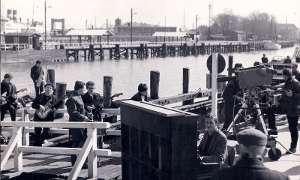
Entering in impressive style the current of the experienced generation of advanced jazz, Józef Krzeczek, exploring the musical world ever more boldly, found the shelf that matched his musical talent. The relevant artistic authorities appointed him leader of the band "Czerwono-Czarni". It is true that leading that formation was not a continuation of the stylistic line he had followed before, that is, the strictly jazz one. Nevertheless Józef Krzeczek tried to bring quasi-elements of that style effectively into the repertoire of the band that was now his. To be exact, both syncopated music and big beat are derived from blues roots. This undeniable fact confirms the conviction that entrusting the leading role to Józef Krzeczek in this already renowned formation called "Czerwono-Czarni" unequivocally defines his artistic qualifications. To conclude this classification of Józef Krzeczek as a performer and creator, there remains an important complement in the form of many hit songs with timeless qualities, which at the same time close the balance - as must be said with enormous sorrow in the context of the peak of the achievements and accomplishments of Józef Krzeczek, who by a decree of fate unfortunately departed too early for a Better World.
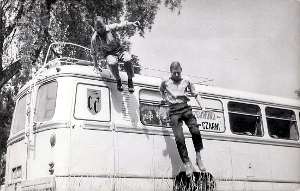
The concept born at the threshold of these reflections - an attempt to bring together two outstanding musicians, diametrically different in personality and in their musical activity, and set in extremely different political systems - came up against extraordinarily resistant material. Considering that the decision once taken ruled out any alternative, and that the awakening regime of ambition did not make the task easier but only piled up negative emotions.
Thanks to a single kindness of Providence, supporting the ever more constructive thoughts that gradually appeared and efficiently ordering the complicated threads, the desired coherence of the sequence was created as a result.
And so, the ruts of helplessness overcome, positive impulses began to flow in, guiding and stimulating the processes of thought onto the current of the desired continuation of the idea conceived at the threshold of this description. Here the bridging sequence that is ending has served as the link joining the two eras mentioned above into one unbroken current of jazz endurance and of the metamorphic changes of its stylistic structures. This made it much easier to move on to describing the way of reaching the necessary level of musical qualifications, and in consequence of performing and creative competence, of the second hero of these reflections. And he is Michał Wierba.
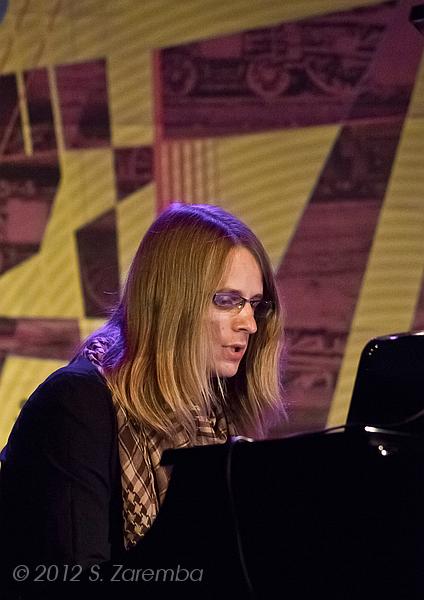
For he, unlike many other musicians for whom the canon, as it were, of entering the world of music, the starting point, was a musical education from the basics and its gradual development at the successive levels of artistic schools, and who only then, on the basis of their musical advancement, made the choice of genre suitable for them.
Michał Wierba, taking up his studies at the Music School, at the same time showed a fascination with jazz music. And his idol was Jan "Ptaszyn" Wróblewski. As time went by, the field of his interest in jazz was gradually and dynamically widened. Listening to syncopated music in various broadcast forms was enriched by taking part in the "Jazzowe Zaduszki", which did not amount merely to the perception of music: for it was an analysis of the technical points of the way of playing the double bass, the drums or the vibraphone. This served, a priori, the right choice of an additional instrument - besides the piano, formally obligatory in musical education.
The singular profile of Michał Wierba - as the later successes of his great talent undoubtedly show most clearly - is given colour by such facts as his accelerated climbing of the rungs of education and above all the ambitious run of intensive music-making for the sake of gradually perfecting his technique and of an overall level rising to the ceiling of the virtuoso, thanks to the extraordinarily talented teacher Stanisława Dutkiewicz. And a sensation of its own, with a special distinction, is the fact that places Michał Wierba in the extremely renowned Jazz Department of the Academy of Music in Katowice, as a teacher at that academy. And equally important splendour and a creative and performing dimension are given to Michał Wierba by multiple honours in the form of first place at a number of jazz festivals and contests - subjected by excellent jurors to strict criteria in the name of an objective classification of performing and substantive class. Hence the supposition of the rich package of winning prizes collected by the Jazz Quintet as the factor of those successes, which unequivocally define its level both in arrangement and in performance.
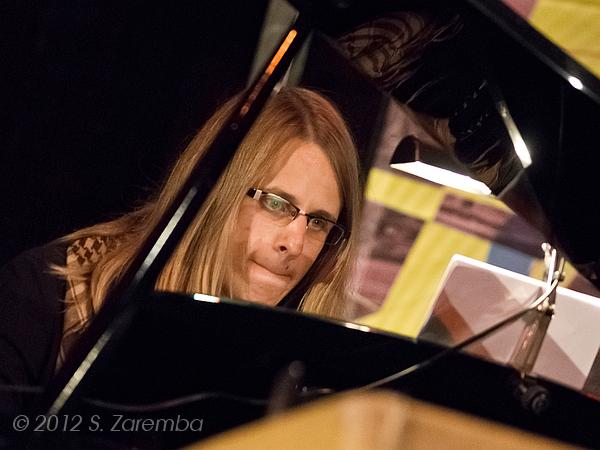
So let us get to know the line-up of the group, worthy of being more widely known, both in persons and in instruments: Marcin Kaleta (ts), Piotr Schmidt (tp), Michał Wierba (p), Michał Kopczuk (b), Sebastian Kuchczyński (dr), leaders of the quintet: Michał Wierba, Piotr Schmidt. Those highly respected, prestigious distinctions undoubtedly bring Michał Wierba as leader of the Jazz Quintet an extraordinary reputation. And the most important forms of honour for their artistic achievements the members of this formation - Michał Wierba in particular - owe to taking part in a number of festivals such as: Jazz Juniors - 2006, Bielska Zadymka Jazzowa - 2008, Jazz Contest - 2008, Tarnów, Jazz Club Ucho Festival - 2009, Getxo Jazz Festival - 2010, Spain. Among the high-ranking presentations one should also count the concert (hosted by Jan "Ptaszyn" Wróblewski) in the Studio named after Agnieszka Osiecka, broadcast by Programme III of Polish Radio.
It is also worth stressing that at all the musical events listed above the Jazz Quintet won the greatest triumph, that is, first place. Nevertheless the modesty of the Quintet's leader does not allow him to list the second and third places won at other contests and festivals.
It remains, then, to believe that Michał Wierba, aspiring at the cost of his code of modesty, will perhaps set in motion a stimulator that will bring the Quintet the highest victories, so that there is no need to play down the lower places. And it should also be acknowledged that in the case of Michał Wierba his artistic achievements so far should give him open space for the unfailing realisation of even the most daring aspirations, since both the band (the Quintet) and the body of facts coming to its aid favour this. All the more so because, in continuing the movement that promotes music of a jazz texture, both in its modernist layer and in an individual refinement woven with a sublime classical sound, as a great young hope seen through the prism of a jazzman and an exceptional personality, creating a subtle alliance of musical genres: a quasi Third Stream, Michał Wierba strides with expression and determination towards significant heights.
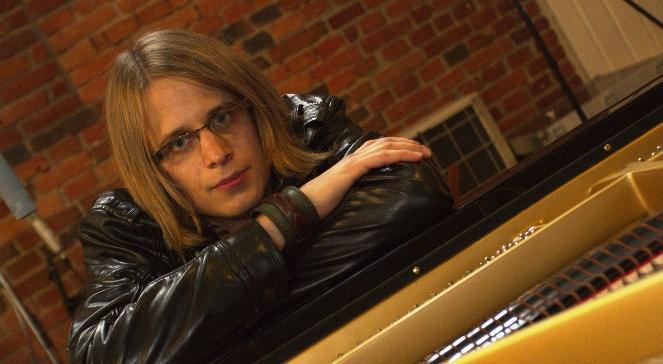
While the undersigned, heading in this way, more or less happily, for the epilogue, must unfortunately confess openly that he is at present going through a phase of working off the tensions he had to struggle with because of the difficult matter of describing the course of events and achievements of two excellent artists, diametrically different both in their work and in personality, in order to arrive in the end at a coherent narrative sequence. So, rounding off this thread, he still remains with a sense of unease. The only comfort is the hope that, as he supposes, the scale of their work has been presented without deficit. Optimism close to the zenith, on the other hand, is brought by the two specially chosen heroes presented here, who put their signature to the work of an unprecedented psycho-sociological transformation in the Nowa Huta community, in the form of the considerable creation and enlargement, and also the unceasing development, of its culture-creating output, felt in a special way by the inhabitants of Nowa Huta. Who with satisfaction feel a pride of their own, an uplifting honour, and with it the desired ennoblement.
So we offer them special thanks and gratitude for their services in building such extraordinarily important foundations for the development of culture-creating values so far, and - by way of anticipation, forecast for the near future - glory and recognition for the second hero, unchangingly alive as a creator and performer. Though most certainly, common to both jazzmen - as highly regarded artists who, for present and future generations of the creatively inspired, have undeniably created lasting foundations making possible the development of the panorama of civilisation and culture on the plane of Nowa Huta - an extra gesture of recognition cannot be withheld. So to those excellent personalities of outstandingly creative disposition, Józef Krzeczek and Michał Wierba (the latter still in the phase of unceasingly heading for the peak of creative artistic values), let us without hesitation offer a symbolic monument, in metaphorical format. So urges the undersigned